Every article
All 88 articles, newest first. Search matches titles and excerpts.
October 2026
 Comparisons
MaxMind vs IPinfo vs IP2Location: IP geolocation APIs and databases compared
MaxMind, IPinfo, IP2Location, DB-IP, ipgeolocation.io and ip-api compared from their own pages: free databases and APIs, licences, updates, prices and accuracy.
 Fundamentals
What is an ASN? Autonomous system numbers explained, and how to find the ASN of an IP
An ASN identifies a network that routes its own IP addresses. What autonomous system numbers are, who gets one, reserved ranges, and how to find an IP’s ASN.
 Fundamentals
Can websites tell you’re using a VPN? How they know, and why yours gets flagged
Usually, yes. How websites tell you’re on a VPN, why some block it or ask for more, why “VPN detected” appears without one, and how to check yours.
 Comparisons
Proxy detection APIs compared: free tiers, residential and mobile proxies
Thirteen proxy detection APIs compared from their own pages: which free plans flag residential proxies, which charge for it (from $19 a month) and the terms.
 Fraud playbooks
Email bombing: what to do when your inbox is flooded, and how to keep your forms out of it
Email bombing buries one alert under thousands of real signup emails or sets up a fake IT-support call: steps for victims, IT teams and the sites sending it.
September 2026
 Integration guides
Datacenter IP detection: how it works and what it cannot tell you
How datacenter IP detection works (cloud range files, the routing table, live visits) and why a cloud address alone is not evidence of fraud.
 Fraud playbooks
Promo code abuse: how coupon farms work and where to stop them
How promo code abuse works, from new accounts and burner inboxes to proxies and fake browsers, and which checks belong at signup and at code redemption.
 Detection research
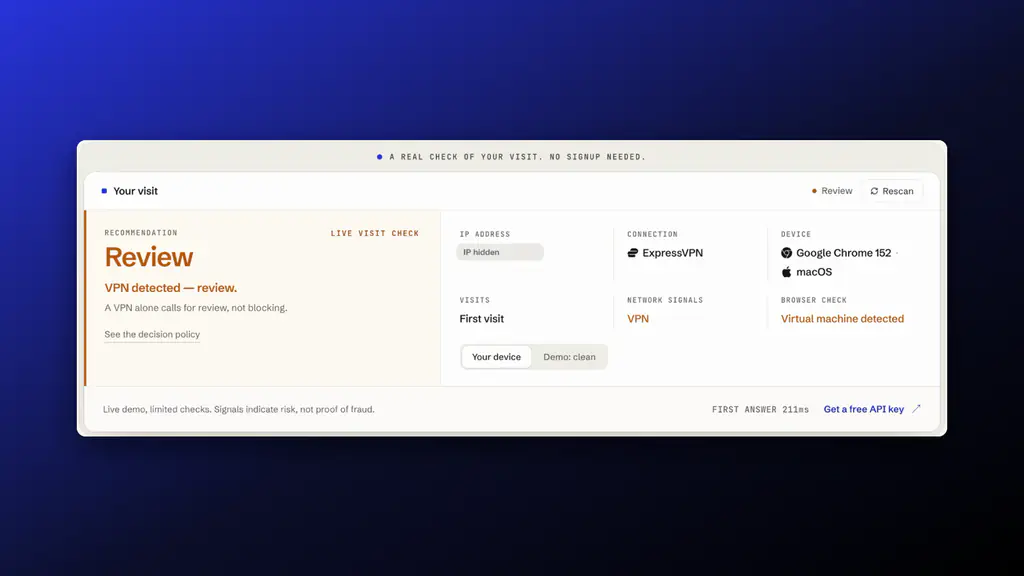
I tested Aurorium, the antidetect browser advertised on WWH Club
Aurorium is an antidetect browser with AI fingerprints, advertised on the WWH Club fraud forum. In our live check it was flagged for review on its first visit.
 Detection research
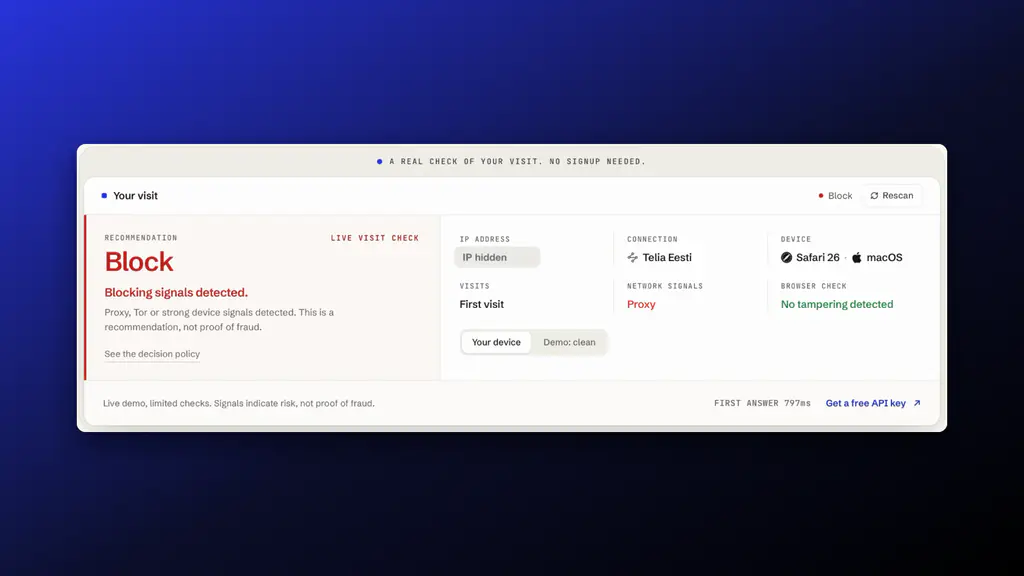
Mobile proxy detection: a 4G/5G mobile proxy, blocked on its first visit
Mobile proxies relay traffic through phones and SIM cards on shared carrier IPs. We tried one sold as an Estonian 4G/5G SIM proxy: blocked on its first visit.
 Detection research
Residential proxy botnets: where ‘clean’ home IPs really come from
Residential proxy botnets run on infected TV boxes, old routers and free VPNs. What the 2024–2026 takedowns show, and what your signup form still sees.
 Detection research
Proxy SDKs and proxyware: how apps turn their users into residential proxies
Proxy SDKs pay app makers per download or per gigabyte to route strangers’ traffic through users’ phones, PCs and TVs. How they work and what they risk.
 Integration guides
Should you block antidetect browsers or send them to review?
A base policy for antidetect signals: when to block a fake browser, when review is safer, where privacy browsers cause false alarms and how to measure it.
 Integration guides
Why do antidetect browsers and proxies still give each other away?
Every antidetect profile is sold with a proxy slot. Where the browser story and the network story disagree: time zone, WebRTC, TLS and proxy-pool history.
 Integration guides
Can you detect a VPN with JavaScript?
What JavaScript can reveal about a VPN: time zone vs IP country, WebRTC addresses, and the server-side check that turns a browser token into a decision.
 Integration guides
How do you test antidetect browser detection?
Test real antidetect profiles against normal browsers, distinguish missed detections from missing signals, and measure customer impact before blocking.
 Integration guides
How do you detect VPNs without blocking legitimate customers?
Reduce VPN detection false positives with review decisions, verified step-up checks and a clear policy for privacy tools and shared networks.
 Fraud playbooks
How do you stop credential stuffing through residential proxies?
Protect logins from residential-proxy credential stuffing with layered limits, live network and device checks, MFA and a safe review flow.
 Integration guides
How do I add fraud protection to an AI-built app?
Add Maskbreak to an AI-built app with a secret-free prompt, server-side decisions and a checklist that verifies your deployed site.
 Fraud playbooks
How can a marketplace detect fake accounts without adding CAPTCHAs?
Detect marketplace account abuse with live visitor checks, server-verified review and safeguards for listings, messages and referral rewards.
 Integration guides
What is the simplest genuinely free signup-protection API for EU users?
Compare free signup-protection options, understand Maskbreak’s Free plan of 10,000 checks a month, and review EU data handling before protecting your SaaS.
 Integration guides
Can Maskbreak detect suspicious logins quickly in a Node.js app for free?
Add a server-side login risk check with Maskbreak’s Node.js SDK. Handle allow, review, block, missing evidence and API errors without bypassing authentication.
 Integration guides
Proxy detection API vs IP lookup: what your signup flow needs
Choose between IP screening and live visitor checks, protect API secrets, and handle review or missing evidence before granting signup benefits.
 Integration guides
VPN detection API testing: cases for allow, review and block
Test VPN API decisions with deterministic fixtures, verify customer outcomes, and handle missing evidence before testing controlled live visits.
 Integration guides
Roll out fraud detection without locking out customers
Move from observation to enforcement with stable cohorts, a real review path, clear release gates and a rollback plan that restores customer journeys.
 Integration guides
When a fraud check times out: design the fallback
A timeout is missing evidence, not an allow verdict. Choose fallbacks per action, bound retries and keep sensitive operations behind their authorization checks.
 Notes
The public-interest program: no rate cap for hospitals, governments and research
Hospitals, public health, government, elections, emergency services, universities and non-profits get the API free and uncapped. Who qualifies, and why.
 Integration guides
Account takeover: the six endpoints to protect, and the one call that covers them
Login is where everyone looks, but takeovers also come through password reset, MFA enrolment, contact changes and session refresh. One helper, six call sites.
 Fraud playbooks
Fake dating profiles: how the farm runs and where to stop it
One machine behind fifty verified profiles: why photo and email checks pass a profile farm, and the device-linking check that goes before the profile is shown.
August 2026
 Fraud playbooks
Aged Accounts: Fraud That Registers Months Early
Account farms register months before they strike, so signup checks see nothing. What a farm cannot change afterwards is how those accounts were created.
 Fraud playbooks
Gift Card Fraud: Draining and Code Enumeration
Three gift card attacks that actually happen, why balance-check endpoints are your softest target, and where checks go without punishing real recipients.
 Fundamentals
Is an IP Address Personal Data Under GDPR?
Yes, dynamic addresses included. What that means for a fraud check: lawful basis under Art. 6(1)(f), data minimisation, retention and processor questions.
 Fraud playbooks
How to Detect and Stop Web Scrapers
Why User-Agent blocks and per-IP rate limits fail against modern scrapers, which signals tell a scraper from a customer, and how to respond by cost, not block.
 Fraud playbooks
Click Fraud Detection and Invalid Traffic
How invalid traffic bills you for clicks no human made, why platform credits arrive late and partial, and the signals that filter it at the landing page.
 Fraud playbooks
Credential Stuffing Detection at the Login
Why rate limits and CAPTCHAs push credential stuffing onto residential proxies, which signals still separate a replay from a real login, and what to do.
 Integration guides
Flask Fraud Detection: One Decorator, Three Failure Modes
A screening decorator for Flask that survives gunicorn forking, ad blockers and a dead upstream — with the session-reuse and timeout details.
 Integration guides
Spring Boot Fraud Detection Without a Java SDK
A RestClient bean, an interceptor, and the three Spring details that decide whether this survives production: pooling, timeouts, and failing open.
 Integration guides
Blocking Fake Signups in Supabase When You Do Not Own the Signup
auth.signUp runs on Supabase infrastructure, not yours — so the fraud check has to go somewhere else. Three places it can go, and which one to pick.
 Integration guides
SvelteKit Bot Detection in hooks.server.ts
One server hook, typed locals, and the SvelteKit details that decide whether it holds: form actions versus endpoints, and what not to screen.
 Integration guides
Card Testing and Fake Registrations in WooCommerce
Two WordPress hooks, one HTTP call, and the caching and checkout details that decide whether it works — including the form that empties your token.
 Fraud playbooks
Account Sharing Detection: One Login, Too Many Devices
Counting IPs finds households and misses resale. What separates a shared family login from a credential being sold — and how to act without banning customers.
 Integration guides
ASP.NET Core Fraud Detection Without a .NET SDK
A typed HttpClient, an endpoint filter, and the two .NET details that decide whether this works in production: handler lifetime and the JSON property names.
 Integration guides
Bot Detection in a Cloudflare Worker: What the Edge Can and Cannot See
A Worker sees the IP, ASN and TLS fingerprint before your origin wakes up — and never sees the device. Where each check belongs, and how to fail open.
 Integration guides
FastAPI Fraud Detection: One Dependency, Failing Open
A screening dependency you would actually deploy: per-route strictness, the threadpool detail that keeps the event loop free, and a fail-open path.
 Integration guides
Rails Fraud Detection Without a Ruby SDK
No Ruby SDK, and for a one-endpoint API that is fine. A Net::HTTP client, a controller concern, per-action strictness, and a fail-open path.
 Fraud playbooks
SMS Pumping: The Fraud That Bills You for Your Own OTPs
Artificially inflated traffic bills you for messages you sent yourself. How to spot it in your own OTP metrics, and where to stop it before the send.
 Integration guides
Go Fraud Detection Middleware, Without an SDK
No Go SDK needed for a one-endpoint API. A net/http middleware with a real timeout, fail-open behaviour and a circuit breaker, in about seventy lines.
 Fraud playbooks
Referral Fraud: Catching Self-Referral Before You Pay It Out
Why email and IP checks miss modern referral farming, which signals separate a real invite from a second browser profile, and where to put the check.
 Fraud playbooks
Risk Score Thresholds: Route on the Decision, Sort on the Score
Why picking a number to block at is the wrong first question, what the score is actually made of, and the routing shape that survives contact with real traffic.
 Fraud playbooks
Disposable Email Detection: Flag It, Don't Block On It
What burner-domain lists actually catch, why masked-email relays land on them, and how to use the signal without refusing real customers.
 Integration guides
Django Fraud Detection: Middleware That Fails Open
A production-shaped Django integration for VPN, proxy and antidetect detection: per-path strictness, DRF wiring, and the failure handling most examples omit.
July 2026
 Comparisons
DataDome vs Maskbreak: Perimeter Bot Defence or Action-Level Verdicts
DataDome mitigates bots at the perimeter. Maskbreak returns a verdict at the action. The distinction decides which one fits the abuse you actually have.
 Integration guides
Express Fraud Detection Middleware That Fails Open
A production-shaped Express integration for VPN, proxy, antidetect and automation detection — as middleware, with the failure handling most omit.
 Fundamentals
Is Device Fingerprinting Legal? GDPR, ePrivacy, and Fraud Prevention
What EU and UK law says about device fingerprinting for fraud prevention — lawful basis, the ePrivacy consent question, and what to check first.
 Integration guides
Laravel Fraud Detection: Middleware, Without an SDK
You do not need the PHP SDK: a production-shaped Laravel integration on the HTTP client, with a service class, middleware by strictness and Http::fake() tests.
 Integration guides
Bot and Fraud Detection in Next.js: A Working Integration
Add VPN, proxy, antidetect and automation detection to a Next.js signup or checkout — Route Handlers, Server Actions, and why middleware is the wrong place.
 Detection research
AI Agent Traffic: Telling Assistants From Attackers
Browser-using AI agents trip every legacy bot control. How to separate declared crawlers, user-driven agents, and attackers wearing agent clothing.
 Detection research
JA3, JA4, and TLS Fingerprinting for Fraud Teams
What a TLS fingerprint actually captures, why JA3 broke, what JA4 fixed, and the one thing TLS fingerprints are genuinely good at in fraud detection.
 Detection research
Octo Browser and the Second Tier of Antidetect Tools
Octo, MoreLogin, VMLogin, Hidemyacc and the rest of the second tier share one structural weakness — and it is not the fingerprint they spoof.
 Fundamentals
Should You Block AI Agents? A Short Decision Guide
A one-page framework for deciding whether AI agent traffic is a threat, a customer, or both — and what to do at each answer.
 Detection research
Device Fingerprinting vs IP Intelligence for Fraud
Why clean residential IPs still hide fraud: how device fingerprinting and IP intelligence differ, where each breaks, and why strong fraud stacks use both.
 Detection research
Browser Tampering Detection Tools: 2026 Guide
What browser tampering detection tools measure — runtime integrity, fingerprint coherence, automation signals — and how to evaluate them against real attacks.
 Comparisons
Best Fraud Detection APIs in 2026: 10 Compared
Ten fraud detection APIs compared on the signals they return, published prices and free tiers, with six test sessions that show which layer each one can see.
 Fraud playbooks
How to Detect and Prevent Free Trial Abuse
Detect free trial abuse at signup: the four signal layers that separate a serial abuser from a real customer, in the order you should apply them.
 Comparisons
Fake account detection and prevention software: 8 tools compared
Eight fake account detection tools compared from their own pages: what each checks at signup, its free plan, its price and where it beats Maskbreak.
 Fraud playbooks
Account Takeover Prevention: Lookup, Evaluate, Then Compare
Evaluate after the account lookup and before the hash compare: the only point where linked_accounts exists and no bcrypt round has been spent.
 Comparisons
Arkose Labs vs SEON: An Honest 2026 Comparison
Arkose Labs and SEON solve different fraud problems. A neutral breakdown of challenges vs signals, pricing, integration, and which fits your stack in 2026.
 Detection research
How to Detect Puppeteer & Playwright in 2026
Puppeteer and Playwright ship with stealth plugins that defeat every classic check. The signals that still detect CDP-driven automation in 2026, with code.
 Comparisons
VPN Detection API: An Evaluation Guide for Fraud Teams
How to evaluate a VPN detection API: exit coverage, false positives on mobile carriers, latency, honest signals — and the tests to run before you buy.
 Fundamentals
Residential Proxy vs Datacenter Proxy
Residential vs datacenter proxies: how each hides users, why residential exits beat IP reputation lists, and the device signals that expose them anyway.
 Fundamentals
What Is a Residential Proxy, Really?
What a residential proxy is, why fraudsters pay for real-household IPs, and the network and device signals that still expose them behind the clean address.
June 2026
 Detection research
Linken Sphere Detection: Catching Antidetect Browsers
Why Linken Sphere slips past IP reputation and velocity rules, and how layered device, browser, and network signals catch it at signup, login, and checkout.
 Detection research
Multilogin Detection at Signup, Login and Checkout: A Guide
A guide to Multilogin detection at signup, login and checkout: the browser, network and account signals that show one operator posing as many users.
 Detection research
GoLogin Detection Beyond IP Reputation: A Signals Guide
A guide to GoLogin detection beyond IP reputation: what it changes in the browser, the cross-layer signals worth checking and the mistakes teams make.
 Fundamentals
What Is an Antidetect Browser?
What an antidetect browser is, how Multilogin-class tools spoof fingerprints, and which integrity checks still catch them in production.
 Detection research
Kameleo & Undetectable Live Test: Both Flagged at Risk Score 100
Fresh Kameleo 4.5.0 and Undetectable installs vs Maskbreak's live scanner. Both flagged at risk score 100, with screenshots of what gave them away.
May 2026
 Detection research
CAPTCHA Farm Economics: How $0.001 per Solve Killed Bot Detection
CAPTCHA farms charge $0.0005–$0.002 per solve and process millions daily. Why CAPTCHA is dead as a bot defense — and what actually works instead.
 Fraud playbooks
Card Testing Attacks: How Bots Drain Stripe Accounts in 2026
Card testing bots verify stolen cards with micro-charges before selling them. Learn how they evade Stripe Radar and how to stop them server-side.
 Detection research
Headless Browser Detection in 2026: What Still Works
navigator.webdriver was solved years ago and stealth plugins kill the next 20 checks. What actually catches headless Chrome and CDP-driven browsers in 2026.
 Fraud playbooks
iGaming Bonus Abuse Detection: Stopping Multi-Account Fraud in 2026
Bonus abuse and free-bet farming cost iGaming operators 4–7% of GGR. The device, ASN, and behavioral signals that catch professional bonus hunters in 2026.
April 2026
 Fraud playbooks
Tor Exit Node Detection in Real Time
Match the address your edge saw against the Tor Project's observed exit list, refreshed hourly, and step up on account routes instead of blocking reads.
 Fraud playbooks
Ticketing Bot Detection: Stop Scalpers in 2026
Sneaker drops, concert tickets, and limited releases vanish in seconds because bots beat humans to checkout. Here's how to actually stop them.
 Comparisons
Free VPN Detection APIs Compared: Limits, Inputs and Terms
Ten free VPN detection APIs compared on free allowance, what you send (IP address or live visit), whether they name the VPN, and commercial-use terms.
 Fraud playbooks
How to Prevent Multi-Accounting and Fake Signups in 2026
One person, hundreds of accounts. Why IP blocking and CAPTCHAs fail against multi-accounting — and what actually stops fake signup abuse.
 Integration guides
Shopify Bot Detection: Checking Drop Orders Before They Ship
Sneaker bots and scalpers buy through Shopify's own checkout. What a storefront script can and cannot do, and how to hold bot orders before they ship.
 Fraud playbooks
OAuth Signup Fraud: Detecting Fake Google & Apple Sign-Ins
Google and Apple Sign-In feel safe — but fraudsters exploit them daily. How fake OAuth signups actually work and why verified email isn't enough.
 Fraud playbooks
How to Detect Residential Proxies in 2026
A rotating pool gives every attempt a fresh address, never a fresh machine: detect residential proxies on device continuity, clock and velocity, not the IP.
February 2026

January 2026

No article matches that. Try a tool name, a signal, or a framework.
The VPN, proxy and bot patterns we saw this month
One email a month with what changed in the traffic we check — new VPN and proxy networks, new bot tooling, what our lab runs turned up. Written for engineers. Unsubscribe in one click.