Can you detect a VPN with JavaScript?
What JavaScript can reveal about a VPN: time zone vs IP country, WebRTC addresses, and the server-side check that turns a browser token into a decision.

Field notes, practical playbooks and integration guides. For the people protecting the next signup, login and checkout.
What JavaScript can reveal about a VPN: time zone vs IP country, WebRTC addresses, and the server-side check that turns a browser token into a decision.
 Comparisons
MaxMind, IPinfo, IP2Location, DB-IP, ipgeolocation.io and ip-api compared from their own pages: free databases and APIs, licences, updates, prices and accuracy.
 Fundamentals
An ASN identifies a network that routes its own IP addresses. What autonomous system numbers are, who gets one, reserved ranges, and how to find an IP’s ASN.
 Fundamentals
Usually, yes. How websites tell you’re on a VPN, why some block it or ask for more, why “VPN detected” appears without one, and how to check yours.
 Comparisons
Thirteen proxy detection APIs compared from their own pages: which free plans flag residential proxies, which charge for it (from $19 a month) and the terms.
 Fraud playbooks
Email bombing buries one alert under thousands of real signup emails or sets up a fake IT-support call: steps for victims, IT teams and the sites sending it.
 Integration guides
How datacenter IP detection works (cloud range files, the routing table, live visits) and why a cloud address alone is not evidence of fraud.
 Fraud playbooks
How promo code abuse works, from new accounts and burner inboxes to proxies and fake browsers, and which checks belong at signup and at code redemption.
 Detection research
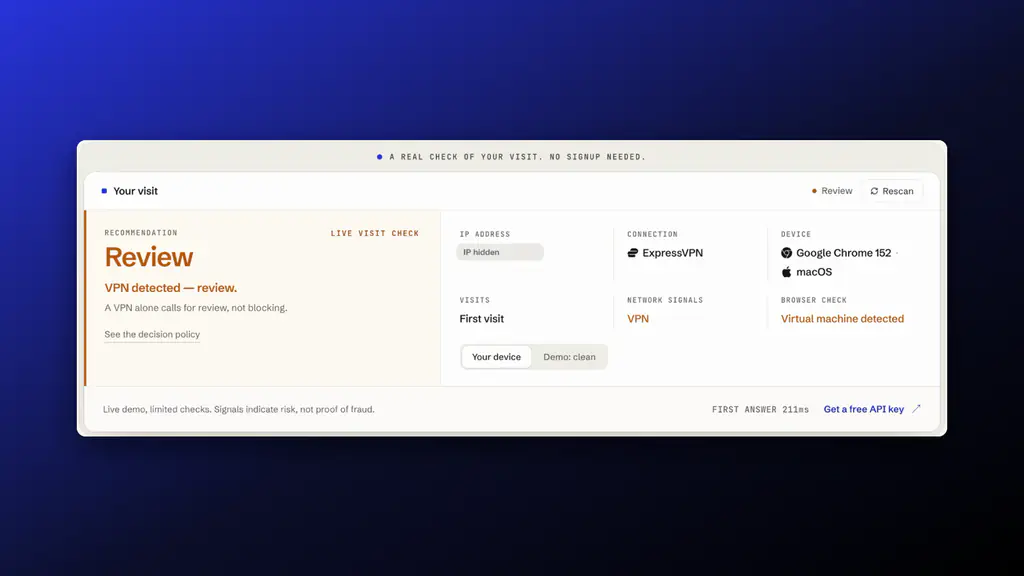
Aurorium is an antidetect browser with AI fingerprints, advertised on the WWH Club fraud forum. In our live check it was flagged for review on its first visit.
 Detection research
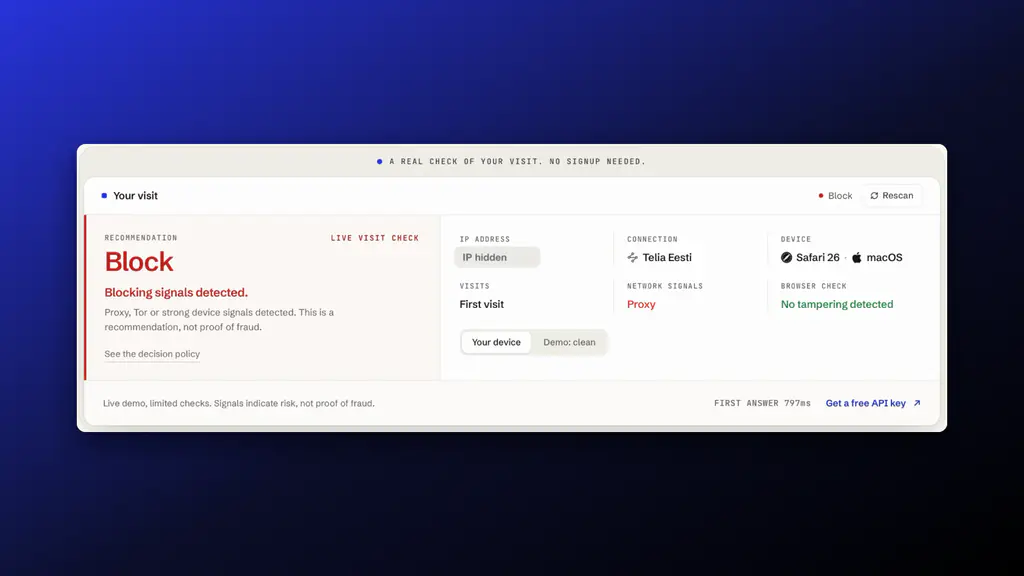
Mobile proxies relay traffic through phones and SIM cards on shared carrier IPs. We tried one sold as an Estonian 4G/5G SIM proxy: blocked on its first visit.

Residential proxy botnets run on infected TV boxes, old routers and free VPNs. What the 2024–2026 takedowns show, and what your signup form still sees.
Proxy SDKs pay app makers per download or per gigabyte to route strangers’ traffic through users’ phones, PCs and TVs. How they work and what they risk.

Browser-using AI agents trip every legacy bot control. How to separate declared crawlers, user-driven agents, and attackers wearing agent clothing.
One attack per post: how it is run, why the usual control misses it, and where the check goes.
All 25 articles
Protect logins from residential-proxy credential stuffing with layered limits, live network and device checks, MFA and a safe review flow.

Detect marketplace account abuse with live visitor checks, server-verified review and safeguards for listings, messages and referral rewards.

One machine behind fifty verified profiles: why photo and email checks pass a profile farm, and the device-linking check that goes before the profile is shown.

A base policy for antidetect signals: when to block a fake browser, when review is safer, where privacy browsers cause false alarms and how to measure it.

Every antidetect profile is sold with a proxy slot. Where the browser story and the network story disagree: time zone, WebRTC, TLS and proxy-pool history.

Test real antidetect profiles against normal browsers, distinguish missed detections from missing signals, and measure customer impact before blocking.
Head-to-heads and category round-ups, including the cases where the other vendor is the right answer.
All 8 articles
DataDome mitigates bots at the perimeter. Maskbreak returns a verdict at the action. The distinction decides which one fits the abuse you actually have.

Ten fraud detection APIs compared on the signals they return, published prices and free tiers, with six test sessions that show which layer each one can see.

Eight fake account detection tools compared from their own pages: what each checks at signup, its free plan, its price and where it beats Maskbreak.

Yes, dynamic addresses included. What that means for a fraud check: lawful basis under Art. 6(1)(f), data minimisation, retention and processor questions.

What EU and UK law says about device fingerprinting for fraud prevention — lawful basis, the ePrivacy consent question, and what to check first.

A one-page framework for deciding whether AI agent traffic is a threat, a customer, or both — and what to do at each answer.
What changed and why.
One email a month with what changed in the traffic we check — new VPN and proxy networks, new bot tooling, what our lab runs turned up. Written for engineers. Unsubscribe in one click.